Microchips to Megasites: How the physical demands of A.I. compute are reshaping land.

By Lex Clay Alfonso

Intel chip Chip tree Moore's law viz Modern GPU chip
The proliferation of data centers traces back to one diminutive piece of technology - the chip. The world’s first commercially available microprocessor, the Intel 4004 - a CPU with 2,300 transistors - came online in 1971. Modern chips introduced by NVIDIA and AMD have billions.
Moore’s Law - the 1965 projection that the number of transistors on a chip would double about every two years - held, well enough through half a century of chip revolution. Transistors were becoming smaller, faster, and more energy efficient. But Moore's Law is nearing the end of its relevance, some experts say.
Why? Because of fundamental physics limits. “The physics of materials changes at atomic levels” researchers at the MIT Computer Science and Artificial Intelligence Lab, explained in a paper. And because of the computer architecture in use by today’s tech giants.
NVIDIA, for example, has managed to cram 80 billion transistors inside of its H100 GPU by using TSMC’s 4 nanometer processing technology - roughly the width of two DNA strands.
When a user asks a language model to perform a task, that request is encoded as electrical signals that travel along etched pathways, and through transistors, which perform many operations at once, in what is called parallel processing.
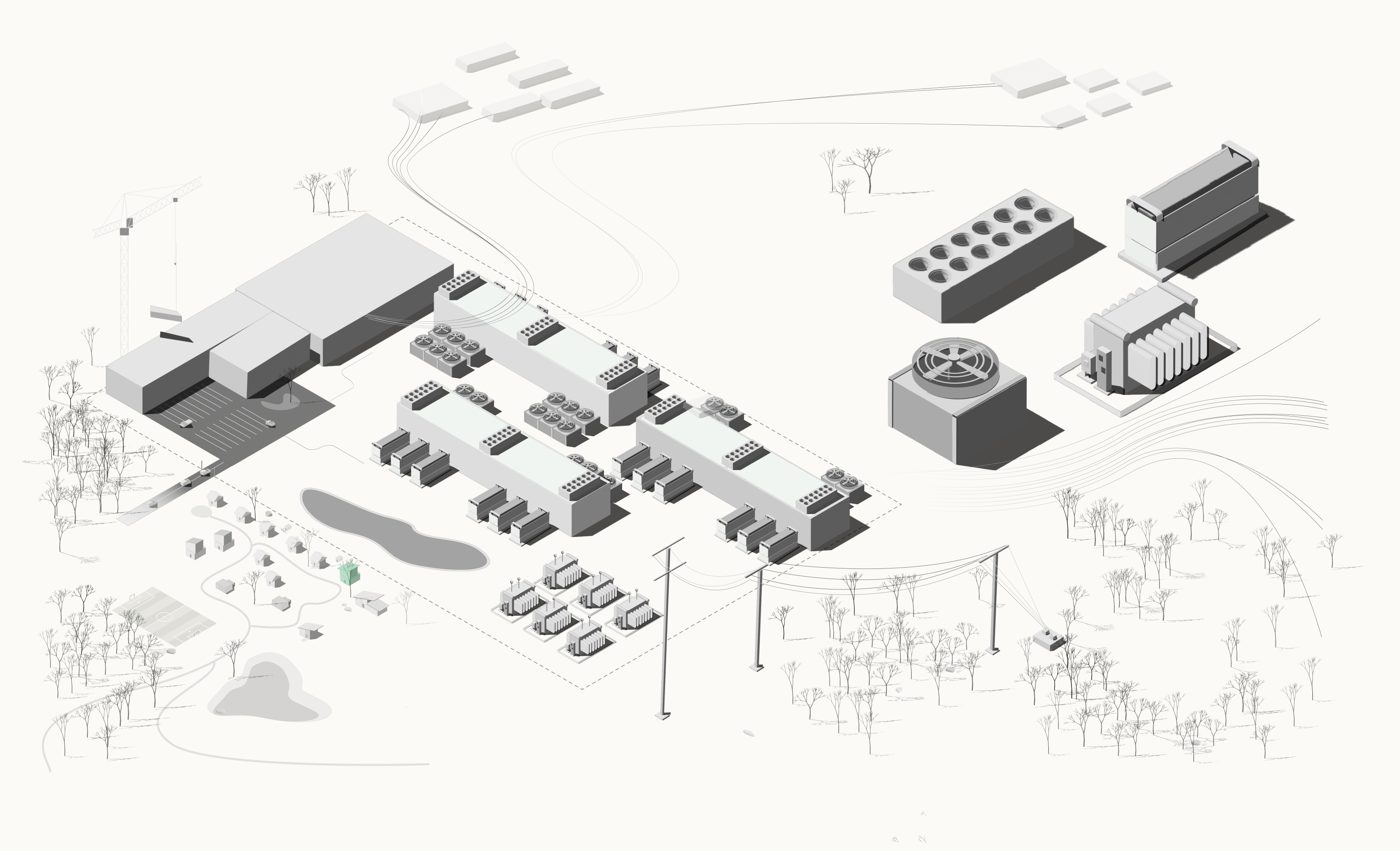
A single microchip — the smallest unit of computation in a modern data center.
1 chip in view
scroll · zoom out

That scale points beyond stand-alone data centers toward clusters of facilities, that like the chips packed within, depend on fast, uninterrupted connection to work in tandem at scale, across communities, cities, and regions.

In the scramble for land, data center developers have found an increasingly attractive commodity in North Carolina - rural land.

A review of listings on ZoomProspector, a popular platform used by local economic development agencies and commercial real-estate brokers, identified eight plots of land that were for sale as of June 2026 for potential data center development.

The largest, an 1,100 acre plot overlapping Davidson and Rowan counties, is listed by real estate and investment firm CBRE, which says it manages 700 data centers in more than 50 countries. The listing advertises potential access to multiple Duke Energy transmission lines, which satellite imagery shows running through the site, and according to a brochure, 500,000 gallons per day of sewer capacity from the City of Lexington.

Other sites, like the $10 billion AWS site in Richmond at the mouth of Duke Energy's Sherwood H. Smith Jr. Energy Complex, are a testament to the increasingly intimate relationship between data burgeoning data centers and existing energy and water infrastructure.

annotated electrical easements
Source: Google Earth
annotated images
Source: Google Earth

That relationship extends beyond quick and easy access to energy. Fiber networks, high-speed vessels that migrate data between data centers and users, have become another prerequisite for A.I. infrastructure. Essentially, they handle at the macro-level what etched pathways do at the micro. But fiber is expensive and can take years to install, and so land situated on existing fiber routes offer developers a headstart.

Image 1
Fiber optic cable. Source: Burgas Free University
Image 2
Source: CBRE

CBRE also sells and leases dark fiber — unused fiber-optic line cable already in the ground — in over 25 states, including, it says, 726 miles of fiber optic cable route in North Carolina.

The specific types of fiber supporting data centers differs from the fiber used to bring high-speed internet to homes, explains a paper released in early 2026 by the Fiber Broadband Association. Nevertheless, it says, rural and small communities who have invested in fiber are gaining new relevance as data center development expands.

Last year, Meta closed a multiyear agreement with Corning worth up to $6 billion, to supply Meta with the fiber-optic cables it needs to grow its data center fleet.

Between 2020 and 2024, bandwidth purchased for data center connectivity spiked by almost 330 percent, according to the Fiber Broadband Association report. An analysis of federal grant data on NC Reports found that in 2025, about 49 percent of all federal funding awarded to North Carolina agencies was broadband related, compared to 27 percent in 2024. In the same time, all other types of federal funding fell to a four year low.

In 2025, the federal government awarded North Carolina more than $300 million in broadband grants to expand high-speed internet to more than 93,000 homes, businesses, and community institutions across the state — a morsel of a $1.5 billion allocation from the National Telecommunications and Information Administration. The remaining roughly $1.2 billion has yet to be awarded. North Carolina wants to spend much of it on continued deployment — reaching homes and businesses still without service and rebuilding lines battered by Hurricane Helene — and the rest on so-called non-deployment uses like workforce development, infrastructure resiliency, and digital adoption.

The catch: the Federal Executive Order on A.I. and an A.I. Action Plan say that states with “onerous A.I. laws” could be found ineligible for non-deployment funds – though the specific conditions are still pending. The order directs the Secretary of Commerce to issue a policy notice – now delayed by months – establishing what continued BEAD eligibility will require.

The decision could have a huge impact on North Carolina. In 2025, CNBC ranked it the top state for business, which for the first time last year, factored in the state's ability to offer large-scale computing power, vacant land, and funding to make sites "shovel-ready.".

The optimism is widespread. "North Carolina has the — and I don't just say this because I live here, even compared to California —I mean, I think we have the best infrastructure to be part of this A.I. revolution," said state Rep. Zack Hawkins, who sits on Governor Stein's A.I. Leadership Council, in a phone interview.

But the contentiousness isn’t lost on him.“I have phone calls from people,” Hawkins said, describing constituents raising concerns about data centers and power- issues the council, he said, has not yet tackled.

“The thing we have to tackle, I believe, “ he said. “is getting the policy right.”

But "right" means different things to different people. The council has spent months on A.I. risk — much of it on the tools themselves: data security, protecting users' information. Less of that attention has reached the physical side of A.I.'s expansion — the data centers, the strain on power and land. For the policymakers courting investment, "right" comes to mean a regulatory touch light enough to keep North Carolina competitive — and eligible for the federal dollars now tied to staying out of AI's way.

As North Carolina builds its own A.I. frameworks, it treads that line with reservation. ”We want to be cautious that we don’t impact that funding in any way,” said then-NCDIT Chief Information Officer Teena Piccione in an IT Strategy Board meeting in February. She urged proceeding with caution as NCDIT waits for regulations to come out from Washington.

“If we have excess, how do we use the funding to build on the foundation we have built for North Carolina,” said Hawkins on BEAD funding. “That’s the billion dollar question.”